AI Opportunity Audit · From €750 · 3 to 5 business days
Stop guessing where AI fits in your business.
A short, paid audit for Irish SMEs that maps your workflows, scores the opportunities, and tells you the smallest useful AI project to build first. No vendor pitches. No transformation theatre. One clear first step.
→ Most SMEs we audit save weeks by building the right first thing instead of the wrong second one.
Scoring matrix
How we score a candidate first project.
Five dimensions. The right first project scores high on repetition and value, low on risk and complexity.
High repetition, high business value, low risk (human-approved), low data sensitivity, low build complexity. Ships in 2–4 weeks. Easy to explain, easy to test.
- Score 4–5 on Repetition + Value
- Score 1–2 on Risk + Complexity
- Has a clear single owner
The problem
Most SMEs know AI matters. Few know where to start.
Three things go wrong before the first project even ships.
External
Where do we even start?
AI is everywhere. The vendor demos all look great. Choosing the wrong first tool wastes a quarter and a budget.
Internal
We're nervous about wasting money.
Without a workflow map, the team picks tools that don't fit, runs pilots that don't ship, and ends up with another subscription nobody uses.
Philosophical
Irish SMEs deserve the same advantage.
Bigger competitors hire consultants and run six-month transformations. You need a faster, cheaper way to see the same opportunity, sized for how you actually run.
Your guide
Maps before tools.
We have spent years inside Irish businesses watching the same pattern. Someone tries a tool. It doesn't fit. They blame AI. The opportunity stays buried in a spreadsheet for another quarter.
The audit exists because the workflow always comes first. We map how your team actually works before recommending anything. Then we score. Then we pick the smallest useful project. That's the order that ships.
- Irish SME focus only. Cork-based, Kinsale-based, working across Munster and remote.
- Workflow first, tool second. We map how your team actually works before recommending anything.
- Plain-English deliverables. No AI hype, no buzzword decks, no transformation theatre.
- Built for non-developers who still want to ship. Every recommendation is one your team can run.

The plan
Three steps to your first AI build.
Map. Score. Recommend. That's the audit.
§ 01
Map
We sit down with you and walk through how work actually moves through your business: enquiries, quotes, jobs, reports, follow-up. Where the time goes, where the handovers fail, where the spreadsheet rules.
§ 02
Score
We rank every workflow opportunity on five criteria: value, repetition, risk, adoption, complexity. The one that wins gets built first.
§ 03
Recommend
You walk away with a workflow map, a prioritised opportunity list, a scoped first project, and a fixed-price build option. You decide what to do next.
What you avoid
Skipping the audit is what costs you.
The three failure modes we see most often when SMEs jump to a tool before mapping the workflow.
Wrong first tool
Most SMEs buy a tool, then look for a workflow to fit it. The audit starts with the workflow.
Wasted budget on a pilot nobody adopts
Without scoring on adoption upfront, even good tech sits unused after launch.
Lose ground to faster competitors
While you debate, the firm down the road ships their first useful AI workflow this quarter.
The outcome
What you walk away with.
Five concrete deliverables. No slide deck filler.
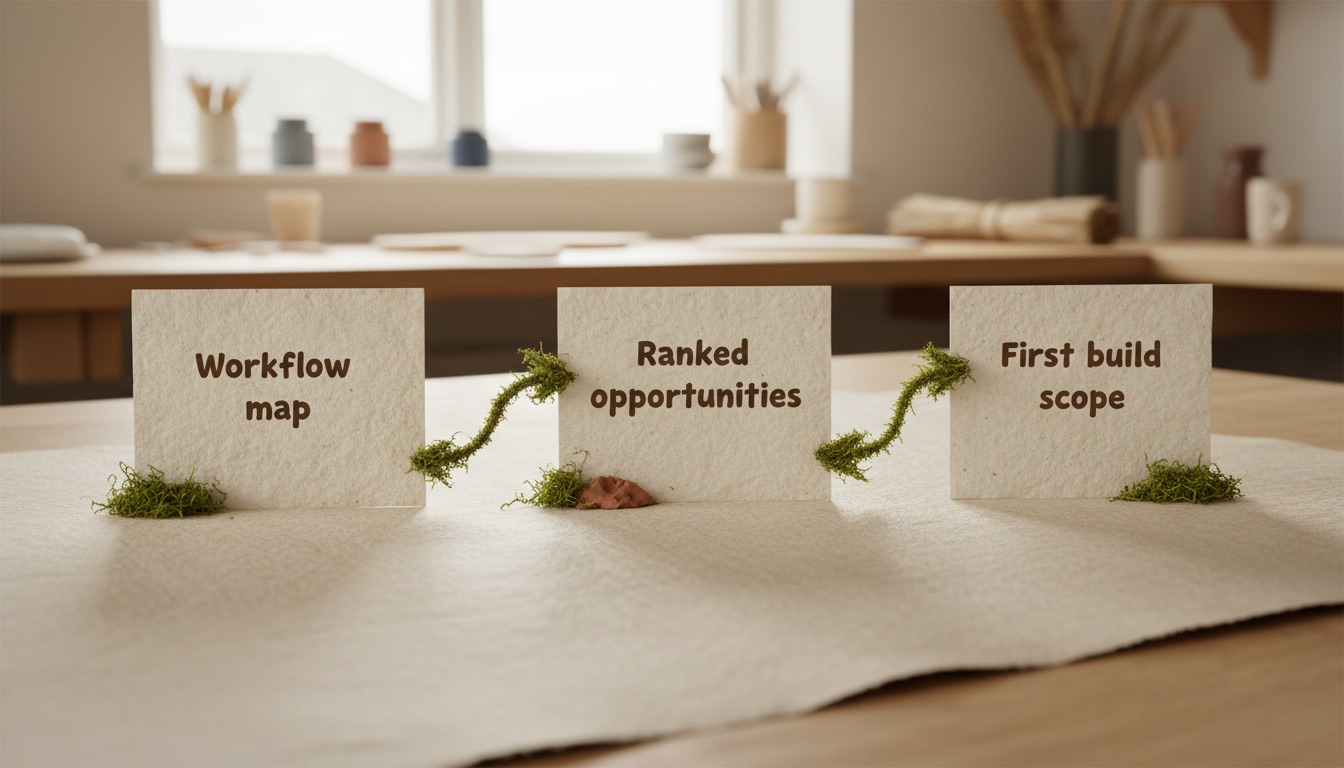
Workflow map
A diagram of how work moves through your business today, with the handovers and bottlenecks marked.
Prioritised opportunity list
Every candidate ranked on value, repetition, risk, adoption, and complexity. The winner is the one we recommend.
First-project scope
Smallest useful version of the winning project, defined so we can build it and your team can adopt it.
Risk and data notes
Where sensitive data sits, what stays inside your systems, where humans approve, what we will not automate.
Fixed-price build option
When scope is clear, you get a fixed-price quote to build the version one. No estimate, no hourly billing surprise.
Why Tús AI
Why work with Tús AI
Tús AI is built for Irish SMEs that want practical AI implementation, not vague AI hype. We focus on useful workflows, realistic budgets, clear scopes, staff adoption, and support after launch.
Our approach is intentionally simple: start with one business problem, build one useful solution, prove value, and expand what works. That is how SMEs can benefit from AI without creating a complicated technology programme or hiring a full development team.
We are also careful about the difference between a demo and a business tool. A demo looks impressive for five minutes. A business tool has to work for staff, customers, managers, and the real exceptions that happen every week. That is why we include scoping, testing, access review, handoff, and support in the way we work.
FAQs
Frequently asked questions about the audit.
How long does an audit take?
Most focused audits take three to five business days after we have the required information. Larger multi-department reviews may take longer.
Do we receive a build quote?
Yes. The audit ends with a recommended first project and a fixed-price build option where enough scope is known.
What does an audit cost?
From €750. Standard SME audits are usually €750 to €1,500 depending on scope. Larger businesses with multiple departments, complex data, or several stakeholder interviews may run higher.
Can the audit support grant conversations?
It can provide a useful project scope, implementation plan, and expected business benefit, but funding approval is handled by the relevant support body.
What if AI is not the right answer?
Then we say that. Sometimes the better first step is a form, dashboard, CRM workflow, training session, or simple automation.
Is the audit paid upfront?
Yes. The audit is paid upfront because it includes analysis, scoping, prioritisation, and a usable recommendation.
What happens after I request a booking?
You receive a reply within one working day with timing, scope confirmation, and payment instructions. The audit kicks off once payment is received.
Get started
One audit. One clear first project. Built for Irish SMEs.
From €750. Delivered in three to five business days. Fixed-price build option included.