Skip to content

Industry

AI Tools and Automation for Irish Solicitors and Law Firms.

We help Irish law firms reduce manual intake, document chasing, repeated client updates, and internal admin by building practical AI-assisted workflows, portals, dashboards, and tools.

The problem

The opportunity is practical workflow improvement, not AI for its own sake.

Irish solicitors and law firms need safer, faster admin, intake, document collection, and client communication workflows. The best first project is usually a repeated workflow that is easy to recognise and painful enough to matter — usually customer communication, internal admin, quoting, documents, reporting, or handovers.

For many Irish SMEs, the problem is not a lack of effort. The problem is that everyday work is spread across email, spreadsheets, shared drives, paper notes, WhatsApp messages, CRMs, accounting software, and staff memory. That creates delays, duplicated work, missed follow-ups, inconsistent customer experiences, and reporting that takes too long to prepare.

AI can help, but only when it is attached to a clear workflow. A tool on its own does not fix a broken process. The useful version starts by asking: what task repeats, who owns it, what information is needed, what decision has to be made, and what should happen next?

What AI for solicitors Ireland means in practice

Admin and intake support, not legal advice.

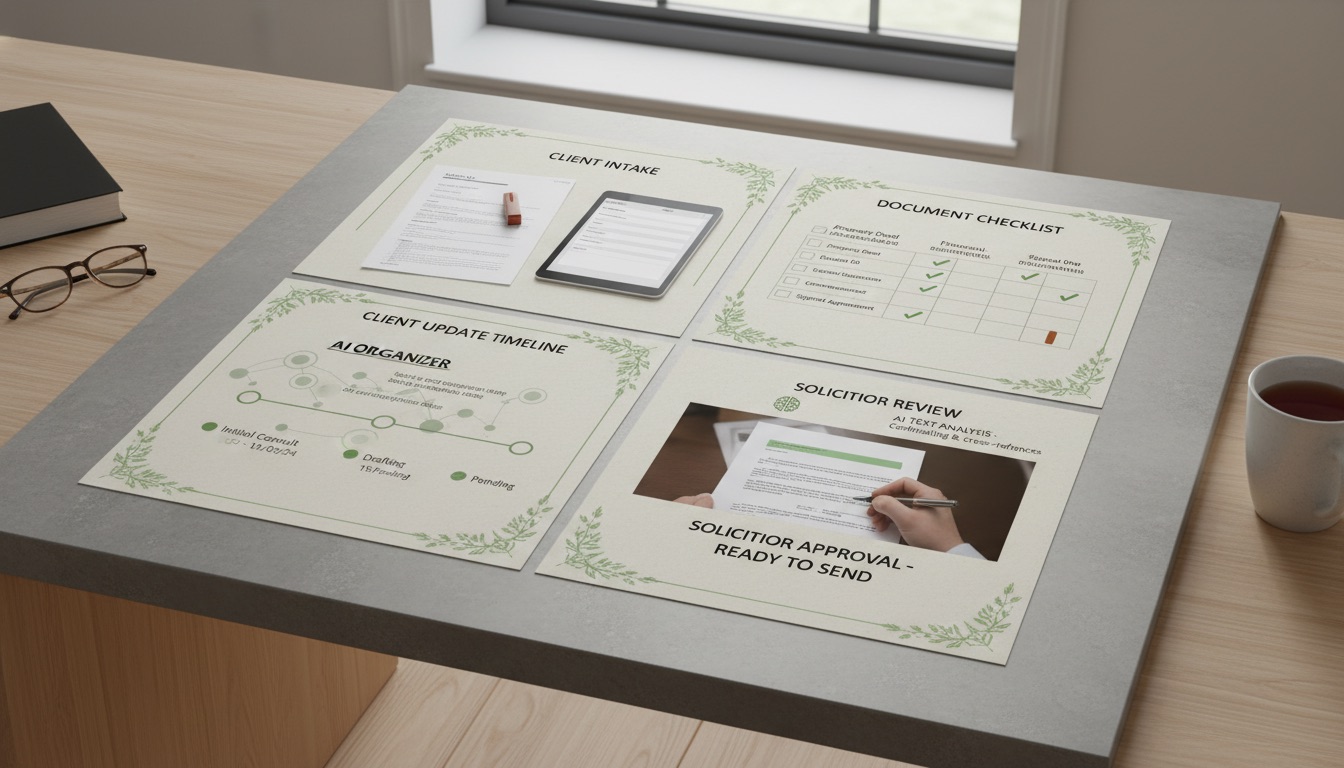
AI should support real workflows: client intake, matter triage, document collection, client portal, meeting notes, and related admin. The goal is not to replace professional judgement. The goal is to reduce repetitive preparation work, make information easier to find, and give staff better systems.

We avoid the common mistake of beginning with a technology and then looking for a use case. Instead, we begin with the business workflow. That means we look at the work your team already does and decide where AI, automation, dashboards, custom tools, or training can remove friction.

The result should be practical. Staff should understand it. Managers should be able to see whether it works. Customers should experience faster, clearer service. The business should be able to improve it over time without starting again from scratch.

What this can include

The most common ways we help.

Client intake

Use AI, automation, dashboards, or workflow tools to improve client intake for this sector while keeping the process practical for staff.

Matter triage

Use AI, automation, dashboards, or workflow tools to improve matter triage for this sector while keeping the process practical for staff.

Document collection

Use AI, automation, dashboards, or workflow tools to improve document collection for this sector while keeping the process practical for staff.

Client portal

Use AI, automation, dashboards, or workflow tools to improve client portal for this sector while keeping the process practical for staff.

Meeting notes

Use AI, automation, dashboards, or workflow tools to improve meeting notes for this sector while keeping the process practical for staff.

Follow-up reminders

Use AI, automation, dashboards, or workflow tools to improve follow-up reminders for this sector while keeping the process practical for staff.

Internal knowledge base

Use AI, automation, dashboards, or workflow tools to improve internal knowledge base for this sector while keeping the process practical for staff.

Lead qualification

Use AI, automation, dashboards, or workflow tools to improve lead qualification for this sector while keeping the process practical for staff.

These are not abstract AI ideas. They are the kinds of workflows where small improvements can compound: fewer manual steps, fewer unanswered messages, fewer duplicate entries, better handovers, and more consistent outputs.

Example workflows

What this looks like in practice.

01

Law firm intake improvement

A law firm has a repeated client intake process that depends on manual emails, notes, spreadsheets, or one experienced team member. We map the current process, identify the repeated steps, create a version-one workflow, and test it with realistic examples before launch.

02

Client or customer communication

The team receives repeated questions and spends time rewriting similar replies. We create an AI-assisted workflow that prepares summaries and suggested responses while allowing staff to approve anything important.

03

Management visibility

The business needs a clearer view of work in progress, follow-up, deadlines, or customer requests. We build a dashboard or internal tool that gives managers one place to check status and next actions.

Who this is for

  • SMEs in this sector with repeated admin or communication workflows.
  • Teams that want practical AI support with human review.
  • Businesses that need dashboards, portals, automation, or custom tools.
  • Leaders who want to start with one contained use case.

It is especially useful when the business has a real workflow problem but does not yet know whether the answer should be AI, automation, a dashboard, a portal, staff training, or a custom app. That uncertainty is normal. Our role is to help you choose the right first project rather than overbuild.

Who this is not for

  • Businesses looking for vague AI strategy without an implementation path.
  • Teams that want to automate sensitive decisions without human review.
  • Projects where no owner, budget, or workflow has been defined.

The best projects have a clear owner, a visible business pain, a realistic budget, and a willingness to start with version one rather than trying to build everything at once.

How we work

A four-step approach.

01

Audit the workflow

We start by understanding the process as it works today. We look at who is involved, what information moves through the process, where delays happen, what tools are already used, and what outcome matters to the business.

02

Define the smallest useful version

We define the version one scope so the team knows exactly what will be built, what is included, what is excluded, and what success looks like.

03

Build, test, and launch

We build the workflow, tool, dashboard, app, or automation. We test it with realistic examples, check the handover points, review permissions, and prepare the team to use it.

04

Improve after real use

Once staff and customers use the tool, we refine language, adjust logic, add missing steps, simplify screens, and improve reporting. This is why we recommend ongoing support for most builds.

Tools and implementation

We choose tools based on the workflow, not fashion.

We choose tools based on the workflow, not fashion. A project may use AI assistants, automation platforms, spreadsheets, CRMs, databases, custom web apps, reporting dashboards, or integrations with systems your team already uses.

The important thing is that the system fits your business. We do not force every client into one platform. We choose the simplest reliable setup that can deliver the outcome, be maintained, and scale sensibly as the business learns what it needs.

Data, privacy, and human review

Sensitive workflows stay safe.

If the workflow involves private, financial, legal, medical, employee, or customer data, we design the scope carefully. The goal is to minimise unnecessary data, keep humans in control of important decisions, and review access rules before launch.

For many SME workflows, the safest first version is human-in-the-loop. That means AI can draft, classify, summarise, suggest, or prepare, but a person reviews important outputs before they are sent to a customer, used in a decision, or stored as a final record.

Pricing and next step

Sector-specific projects start with a €750–€1,500 audit.

The usual starting point is an AI Opportunity Audit from €750–€1,500. Focused quick-win builds may start from €2,500–€6,000. Sector-specific portals, dashboards, and custom tools usually require a larger scoped build.

The audit gives you a clear recommendation, a scoped first project, likely risks, and a fixed-price build option.

Why Tús AI

Why work with Tús AI

Tús AI is built for Irish SMEs that want practical AI implementation, not vague AI hype. We focus on useful workflows, realistic budgets, clear scopes, staff adoption, and support after launch.

Our approach is intentionally simple: start with one business problem, build one useful solution, prove value, and expand what works. That is how SMEs can benefit from AI without creating a complicated technology programme or hiring a full development team.

We are also careful about the difference between a demo and a business tool. A demo looks impressive for five minutes. A business tool has to work for staff, customers, managers, and the real exceptions that happen every week. That is why we include scoping, testing, access review, handoff, and support in the way we work.

FAQs

Frequently asked questions.

What is the best first AI project for this sector?

Usually the best first project is a repeated, low-risk workflow such as enquiries, document collection, quote preparation, report summaries, or internal knowledge support.

Can AI make decisions for us?

We generally recommend AI-assisted workflows with human review, especially where customer, legal, financial, health, employment, or operational decisions are involved.

Can this connect with our existing tools?

Often yes, depending on the systems and available integrations. We review your current tools before recommending a build.

How much does a sector-specific AI project cost?

Start with an AI Opportunity Audit from €750–€1,500. Quick wins may start from €2,500, and custom tools are quoted after scoping.

Can you train our staff too?

Yes. Training can be included so staff understand how to use the new workflow safely and consistently.

Get started

Find the best first AI or automation project for your business.

Tell us where your team is losing time. We will help you identify one workflow that can be improved with AI, automation, a dashboard, or a custom tool, then show you the practical path to build it.